Aberdeen
About the Aberdeen Project
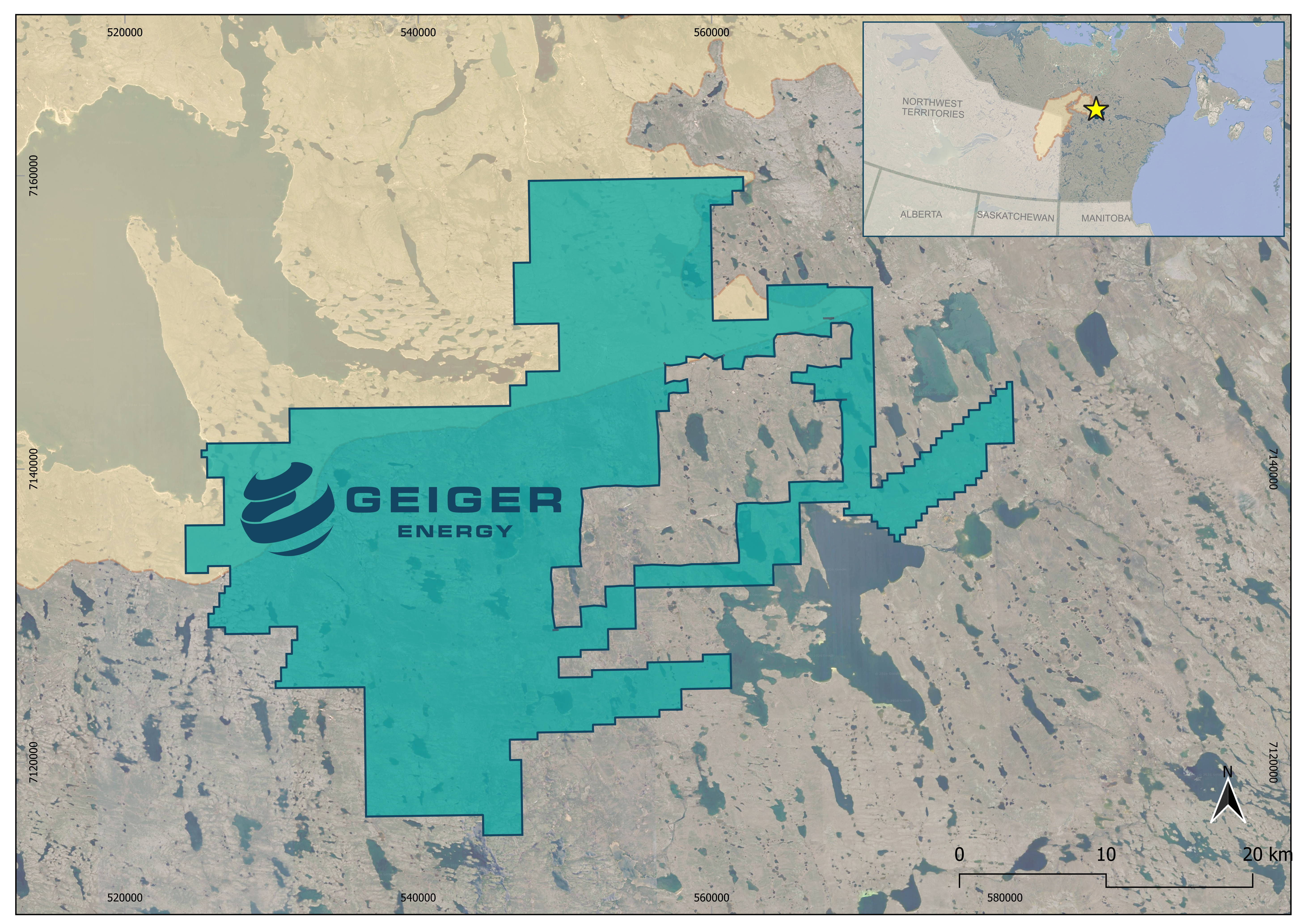
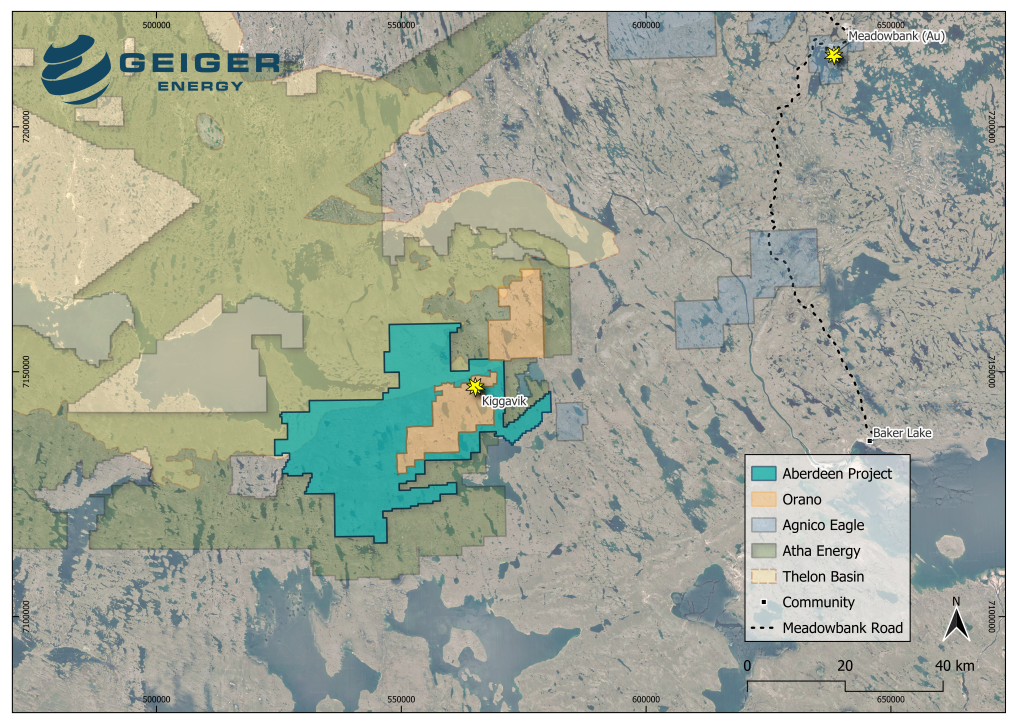
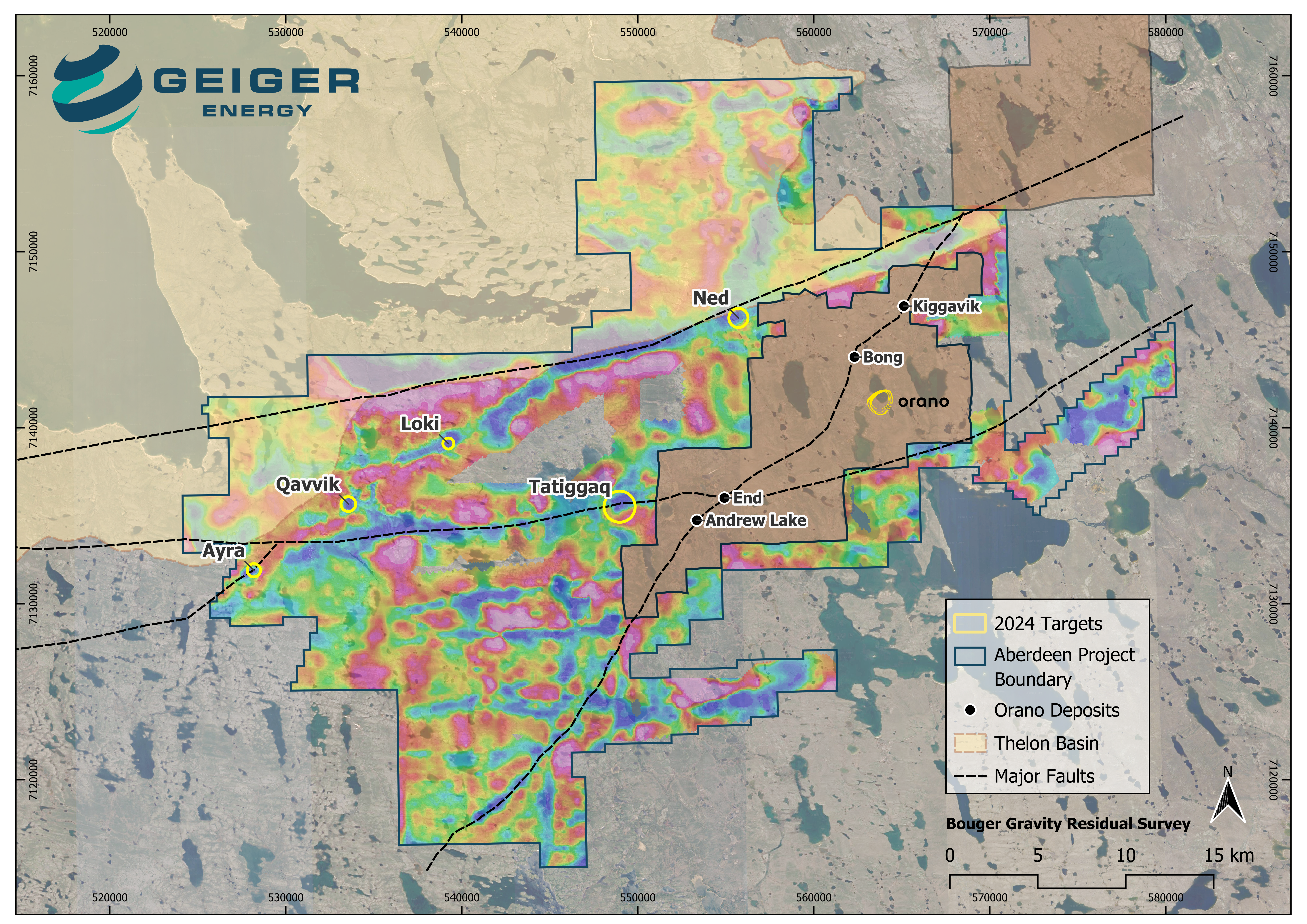
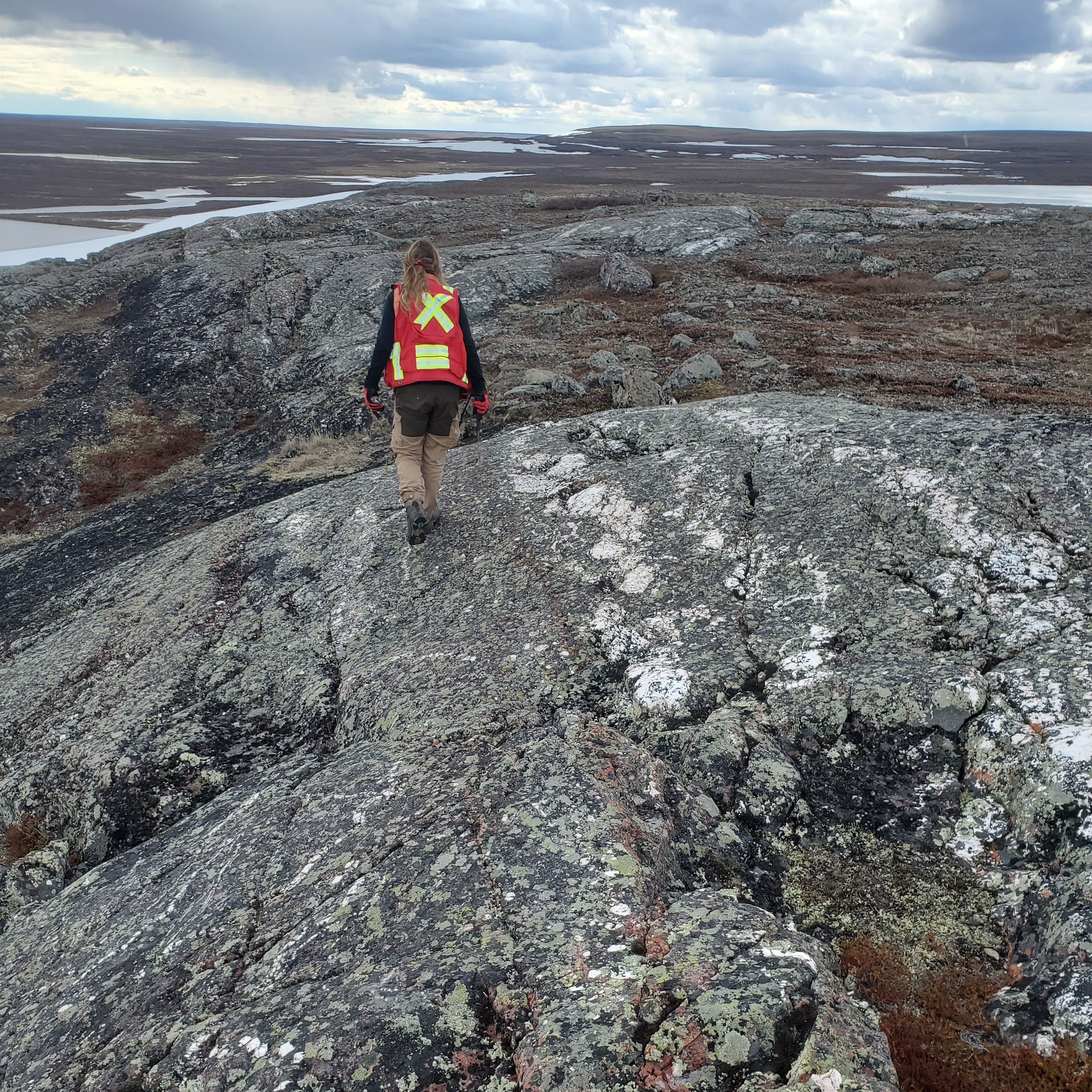
The Aberdeen Project is a 100%-owned uranium exploration project held by Geiger Energy, located on the northeast edge of the Thelon Basin in Nunavut, approximately 100 kilometres west of the Hamlet of Baker Lake. The project consists of 40 claims totaling 53,402 hectares. The Thelon Basin is regarded as one of the most prospective areas globally for discovering high-grade, unconformity-style uranium deposits outside of Saskatchewan’s Athabasca Basin.
Location and Infrastructure
The Aberdeen Project is located on the northeast edge of the Thelon Basin in Nunavut Territory, approximately 100 kilometres west of the Hamlet of Baker Lake. Baker Lake is accessible by aircraft and is connected to Hudson Bay via Chesterfield Inlet, which also services Agnico Eagle’s Meadowbank mine. The project lies on trend with the Kiggavik uranium deposit, which hosts a historic indicated resource of 127.3 million pounds grading 0.55% U₃O₈ and a historic inferred resource of 5.4 million pounds grading 0.33% U₃O₈. Cut-off grades and other estimation parameters are not publicly disclosed. Kiggavik is currently owned by Orano Canada (66.2%), Denison Mines (16.9%), and UEX Corp. (16.9%).
2026 Program
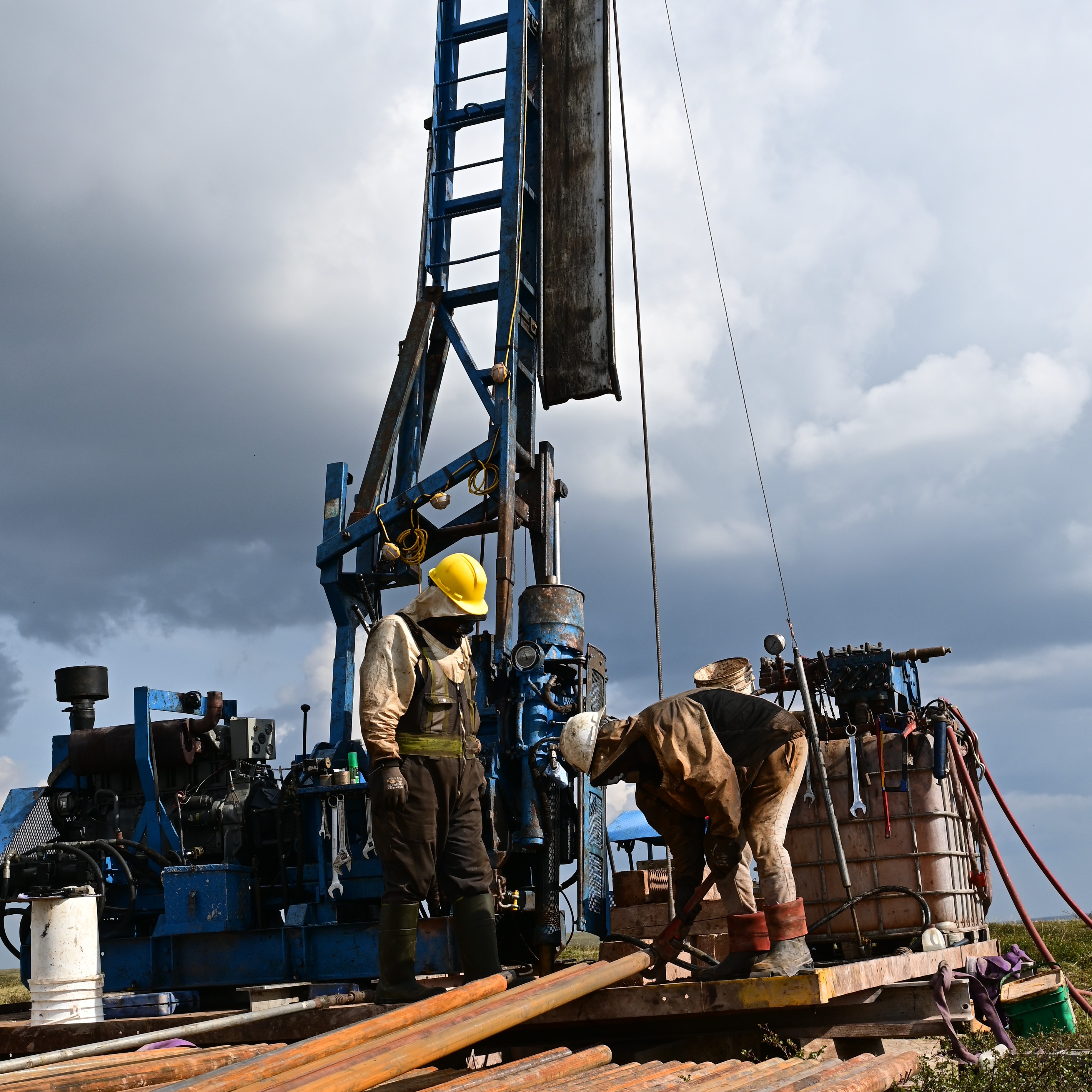
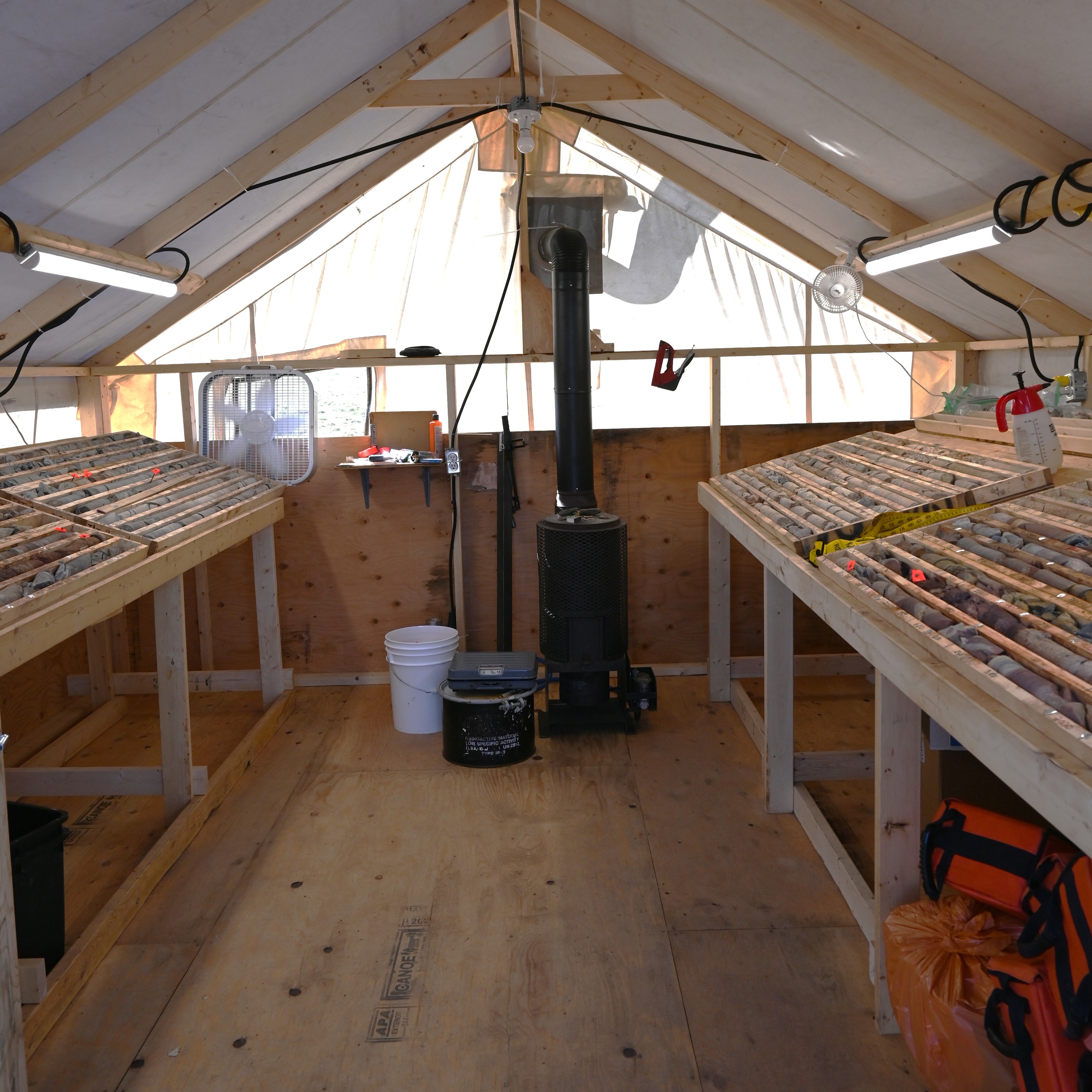
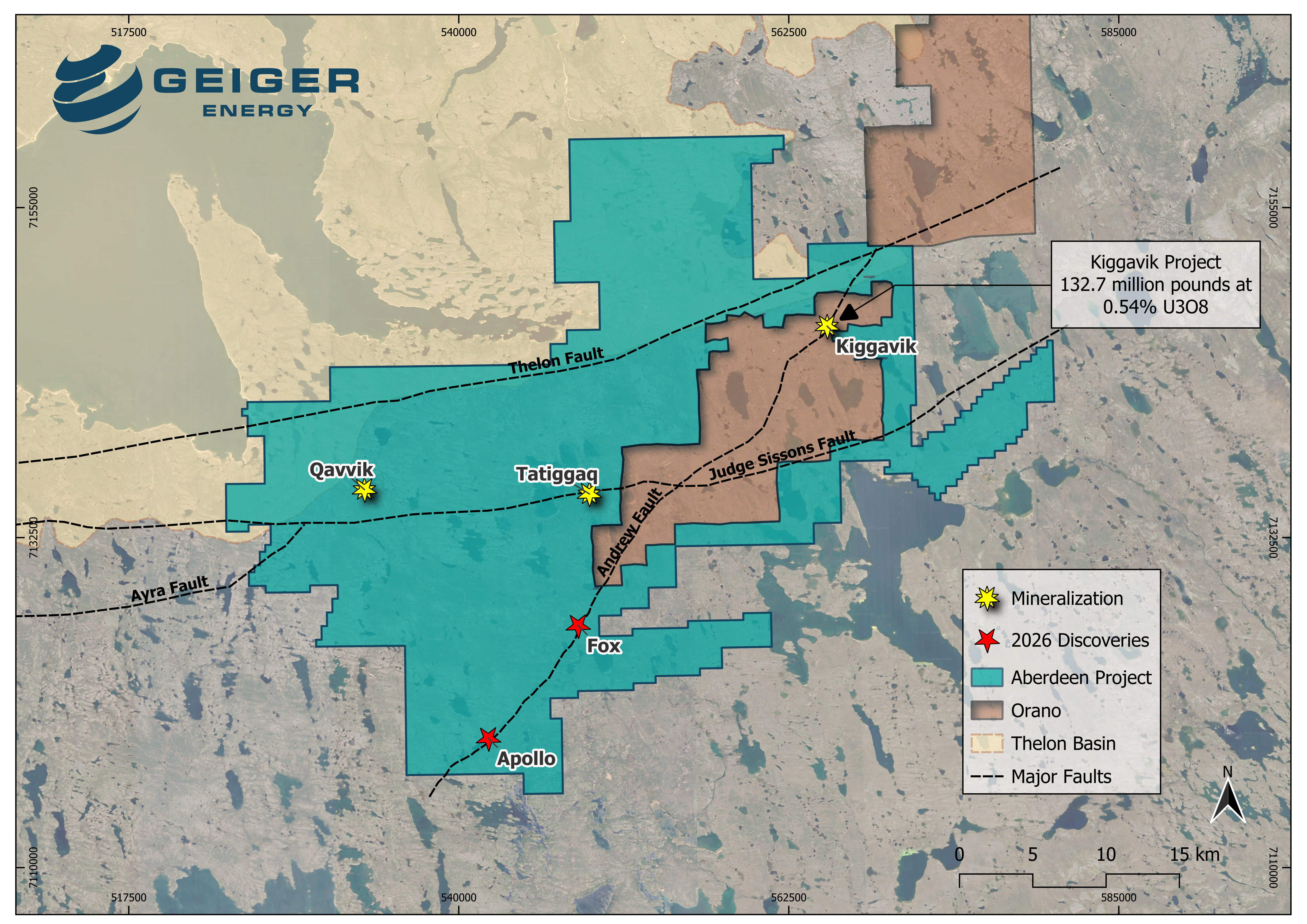
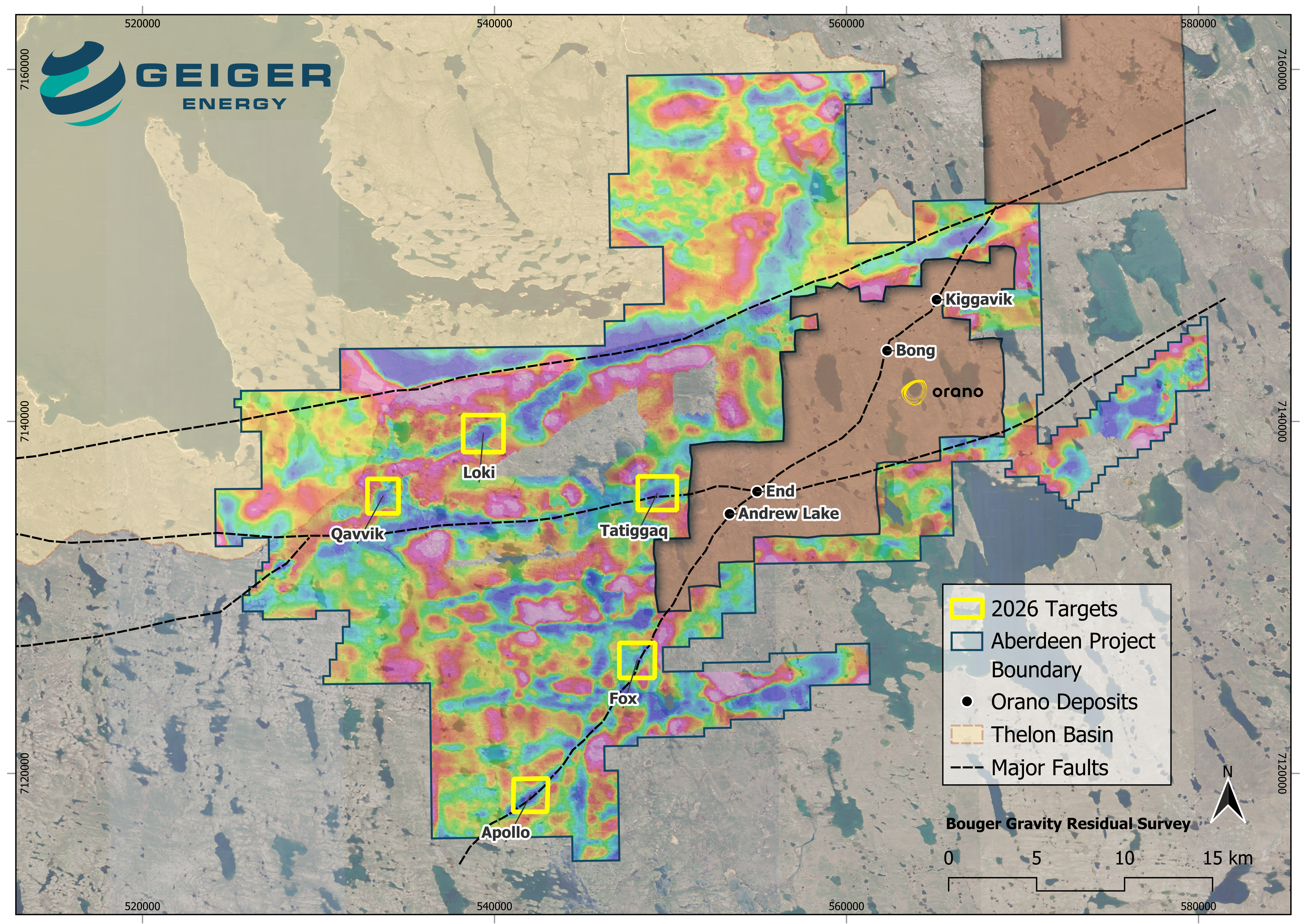
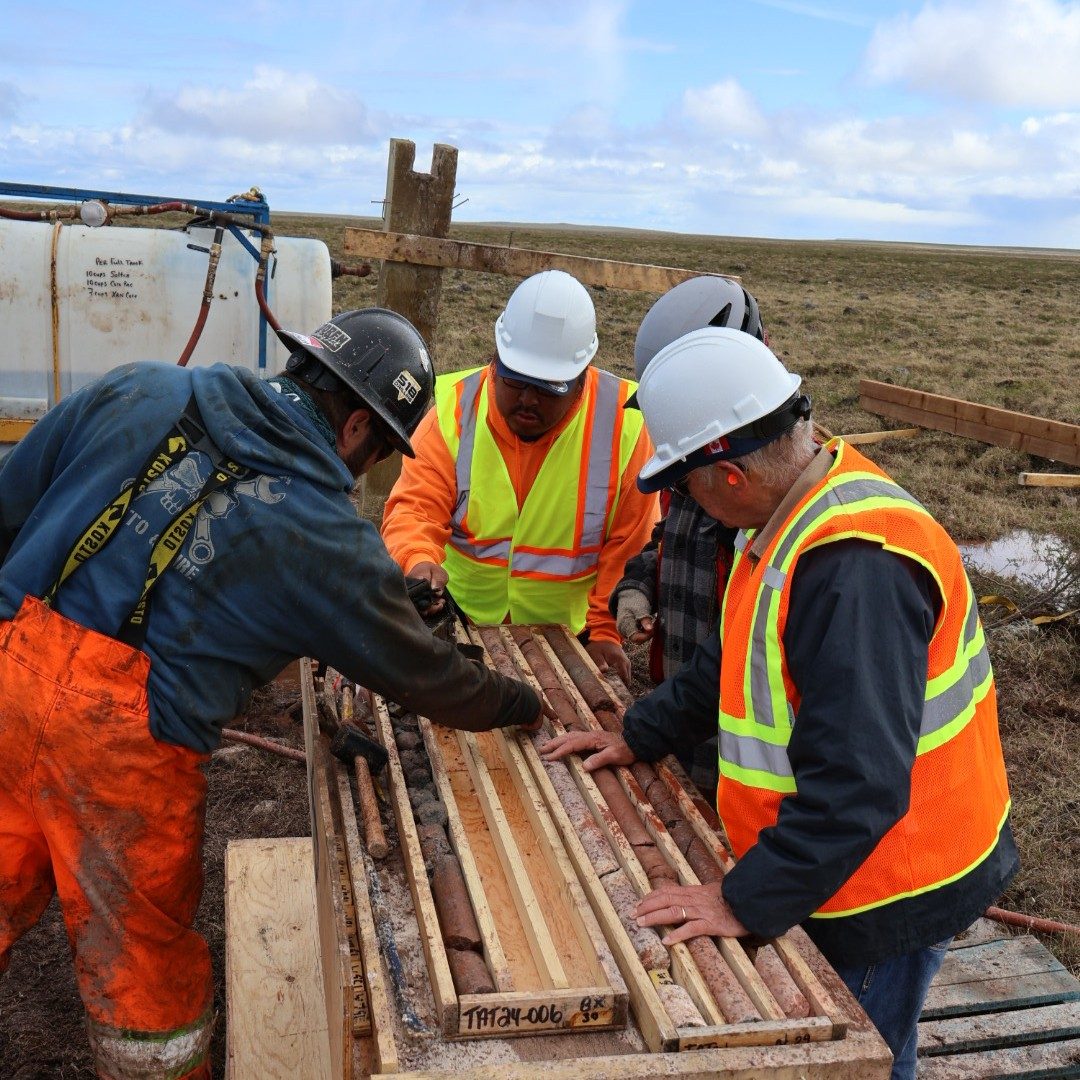
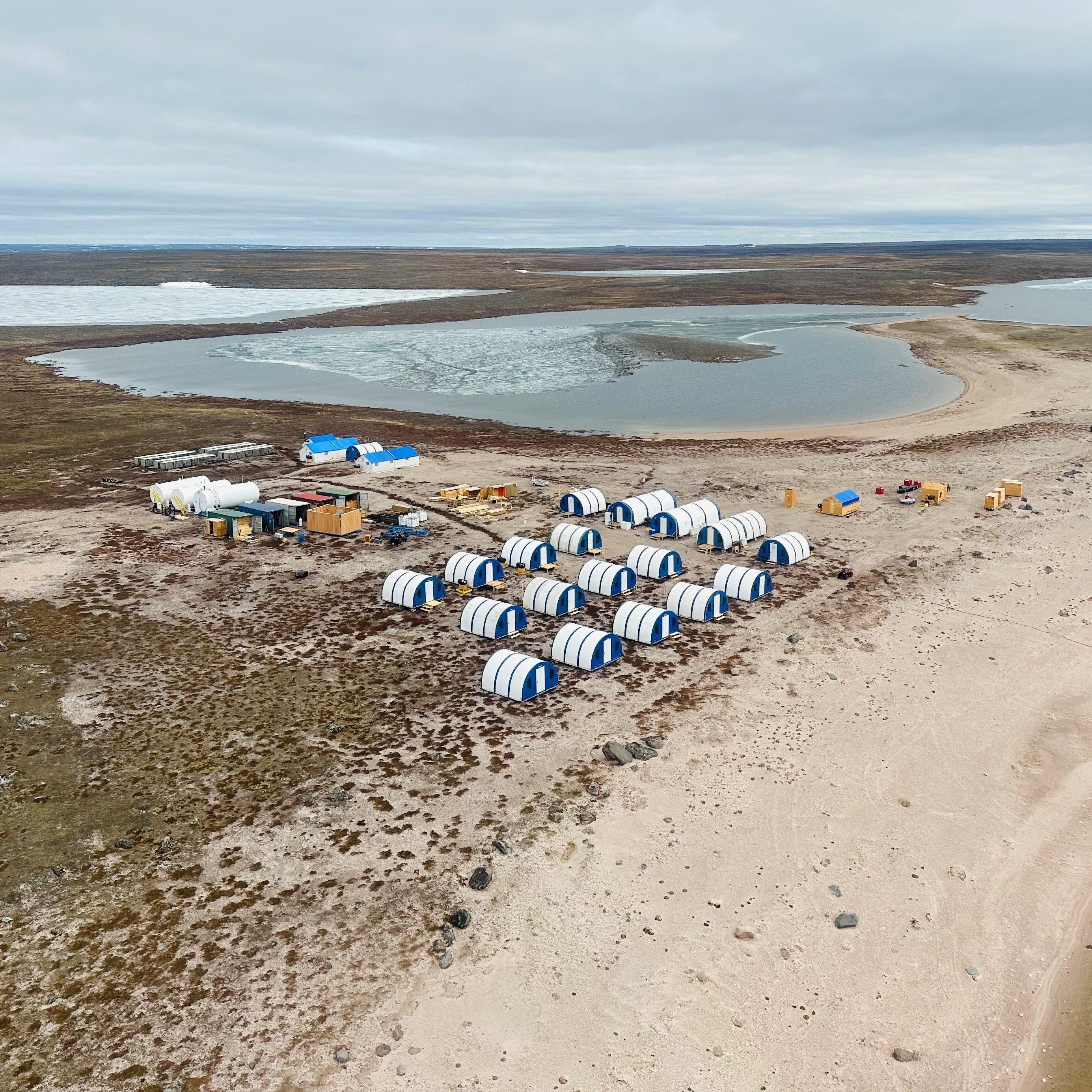
Geiger Energy has completed a two-drill exploration program at the Aberdeen Project, totaling approximately 6,500 metres across 26 drillholes. The drill program focused on the Loki and Tatiggaq target areas as well as other high-priority targets using current airborne geophysics. Geiger's target generation model, which focuses on gravity lows along reactivated structures, led to two new greenfield discoveries at the previously untested Fox and Apollo targets.
Fox and Apollo sit directly on the Andrew Lake Fault, along strike from Orano’s Kiggavik area deposits. The corridor extends 17 kilometres across the Aberdeen project, with numerous analogous targets that remain untested.
Two New Discoveries, One District
*Radioactivity values are from downhole probe readings and are not a substitute for chemical assays.
2026 assay results pending.
2025 Program
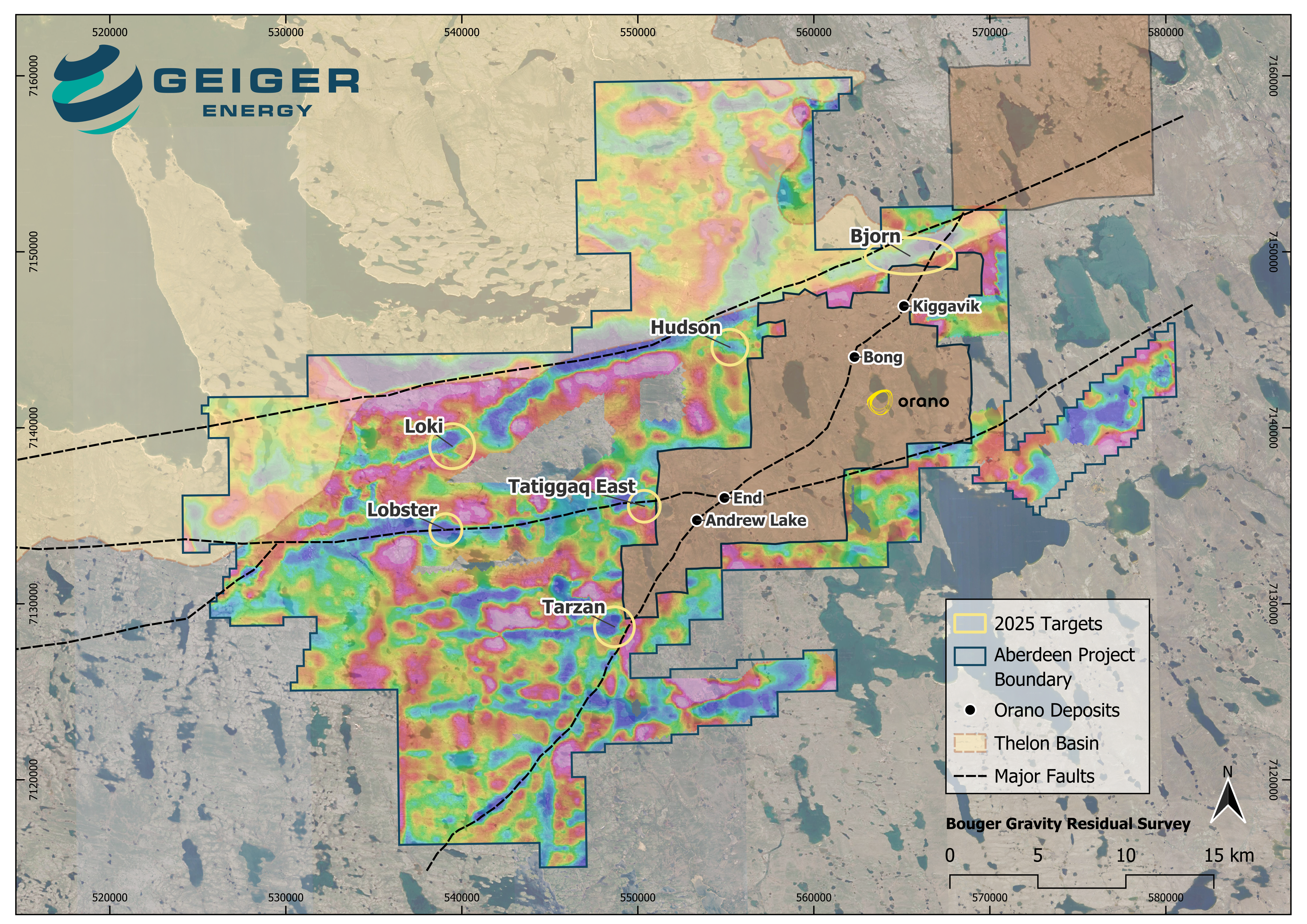
After the merger announcement between Forum Energy Metals and Baselode Energy the newly formed, Geiger Energy completed an exciting two-drill exploration program totalling 5,300 metres of drilling across 20 drillholes. Geochemical results confirmed widespread uranium enrichment and large-scale hydrothermal systems at four high priority targets: Loki, Bjorn, Tarzan, and Lobster.
Loki
The Loki target is an almost 4-kilometre gravity low trend that hosts Thelon sandstone cover less than 175 metres thick. A total of nine drill holes tested the Loki area with uranium enrichment (>1 ppm U) intersected in 7 of 9 drillholes with a maximum of 119 ppm U.
- The first confirmed uranium at the unconformity in the northeast Thelon Basin
- Broad sandstone-hosted intervals with weighted averages of 1-3+ ppm U over 120-150 metres
- Highly anomalous Pb-isotope ratios indicative of radiogenic uranium sources
- Extensive clay alteration, bleaching, sulphides, and post-sandstone faulting
- Pathfinder elements (Mo, Ni, Co, B) consistently elevated
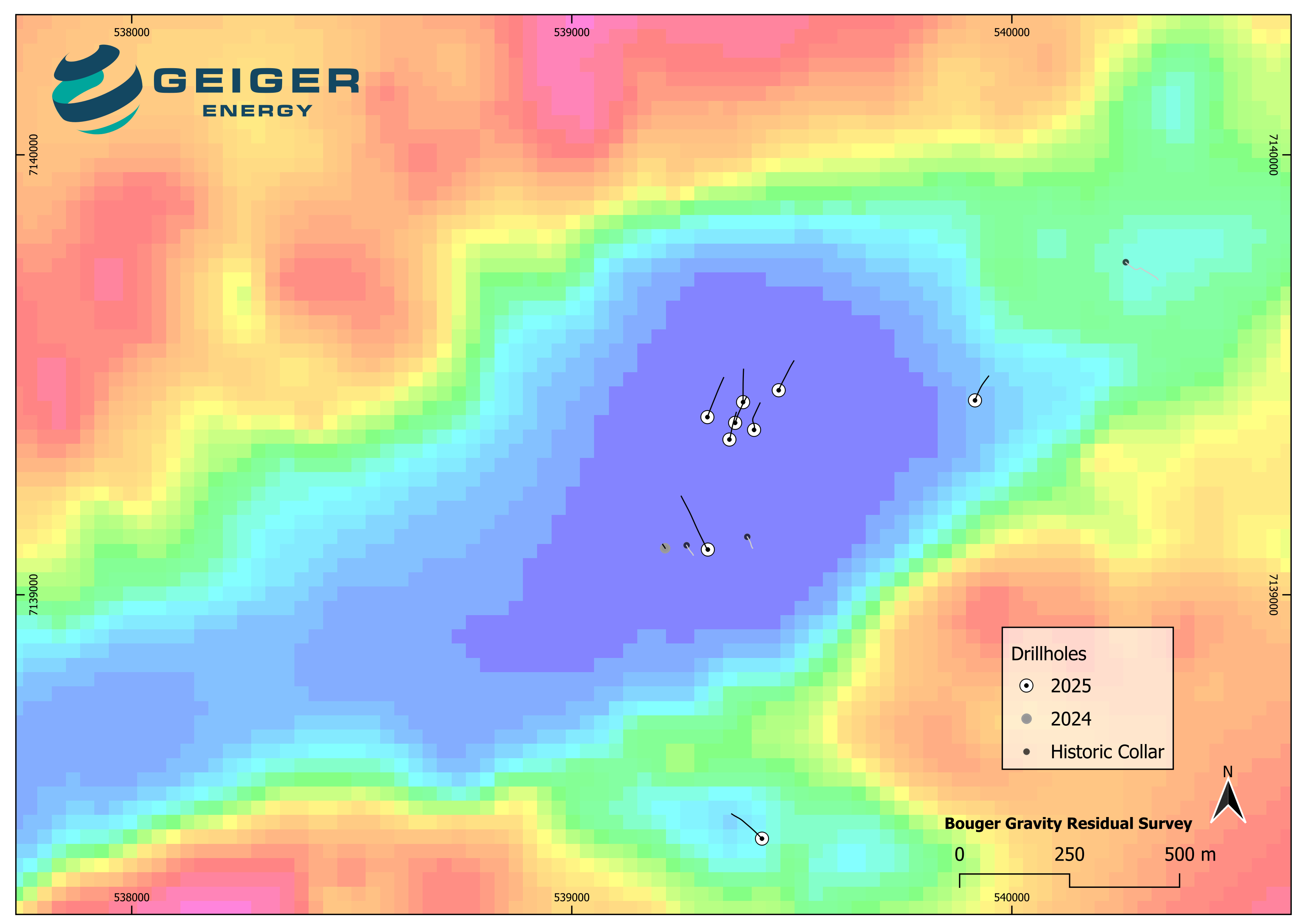
Enriched uranium at the unconformity intersected in LOK25-007 with values of 119 ppm U over 0.6 m (164.1 to 164.7 m), LOK25-008 with values of 6.4 ppm U over 6.8 m (159.0 to 165.8 m), and in LOK25-010 with values of 43.1 ppm over 0.7 m (171.3 to 172.0 m).
LOK25-004, -006, -007, -008, -009, -010 and -012 all intersected elevated (> 1 ppm U) in the sandstone and up to 77 ppm.
Lobster
Lobster confirms basement-hosted uranium potential and adds diversity to the discovery pipeline.
- Strong alteration and fault-controlled hydrothermal activity
- Highly anomalous boron (up to 1,790 ppm) and elevated uranium
- Indicates a major fluid system capable of mineralization
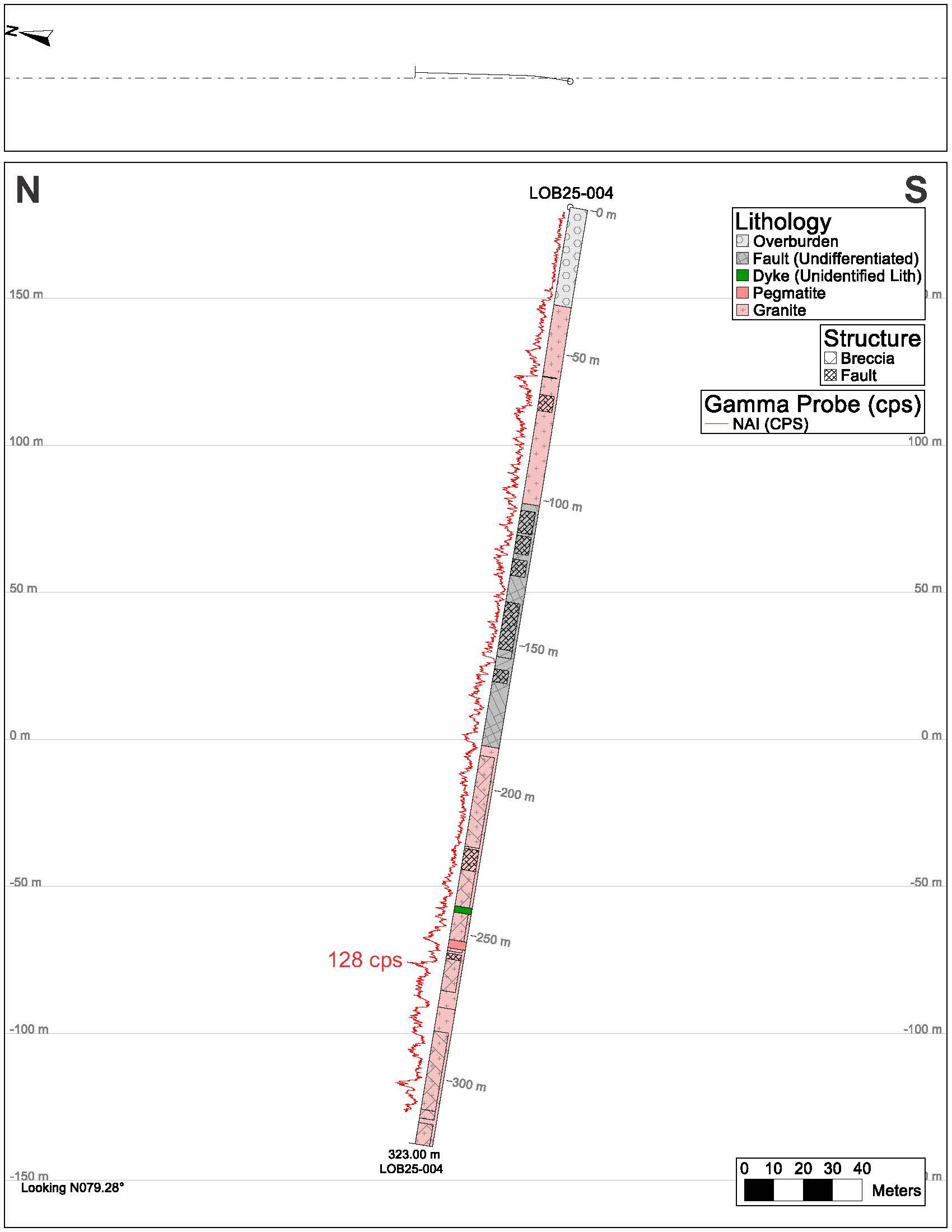
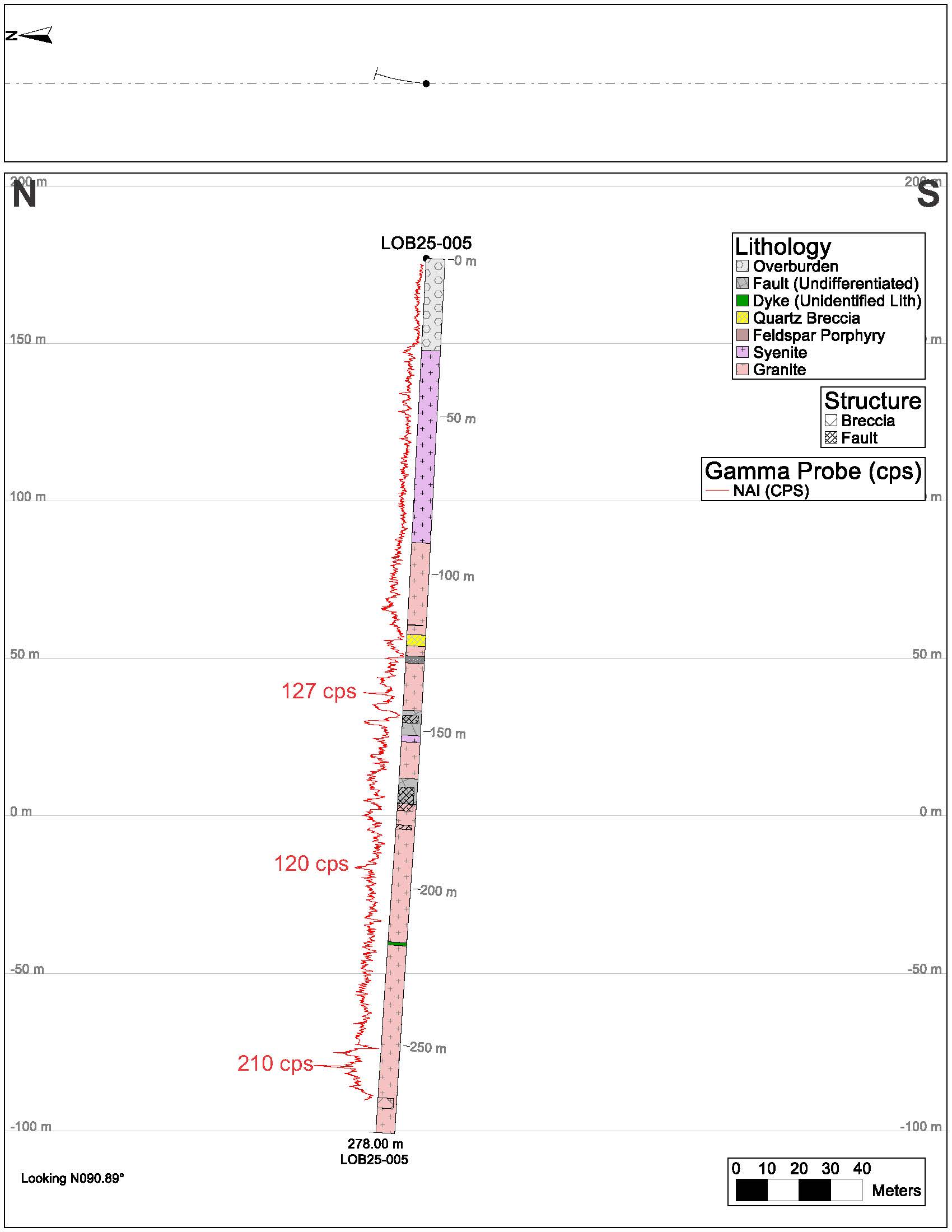
The Lobster Grid is a significant gravity and magnetic low anomaly along the Judge Sissons fault and two holes were completed in 2025 to test this large anomaly area. A few historical holes were completed in the area that intersected extensive clay alteration and fault rock that warranted further testing. This target area is a basement target with no Thelon Formation sandstone cover.
- LOB25-004 and LOB25-005 intersected highly altered gneiss, intrusive rock and fault rock with significant sections of strong pervasive bleaching and clay (toothpaste consistency). The strong alteration of the fault rock (quartz stockwork) shows significant hydrothermal penetration of a largely fluid barrier rock type and indicative of a major hydrothermal system moving through the area.
- Highly anomalous boron geochemical values are present throughout both drill holes with values as high a 1,790 ppm B at 125 m in LOB25-004. Elevated uranium up to 16.7 ppm was intersected at 305 m (LOB25-004).
Bjorn
Bjorn represents a major, largely untested system with strong potential.
- Only three holes have tested the >3 km gravity and magnetic low anomaly - two Geiger holes and one historic Cameco hole
- Hundreds of metres of bleached, altered sandstone and conglomerate
- Evidence of sustained hydrothermal fluid flow along the Thelon Fault
- Elevated uranium and pathfinder elements confirm system fertility
The Bjorn Grid is a strong gravity and magnetic low anomaly along the Thelon Fault which has Thelon Formation sandstone cover. Two drill holes tested this very broad anomaly area.
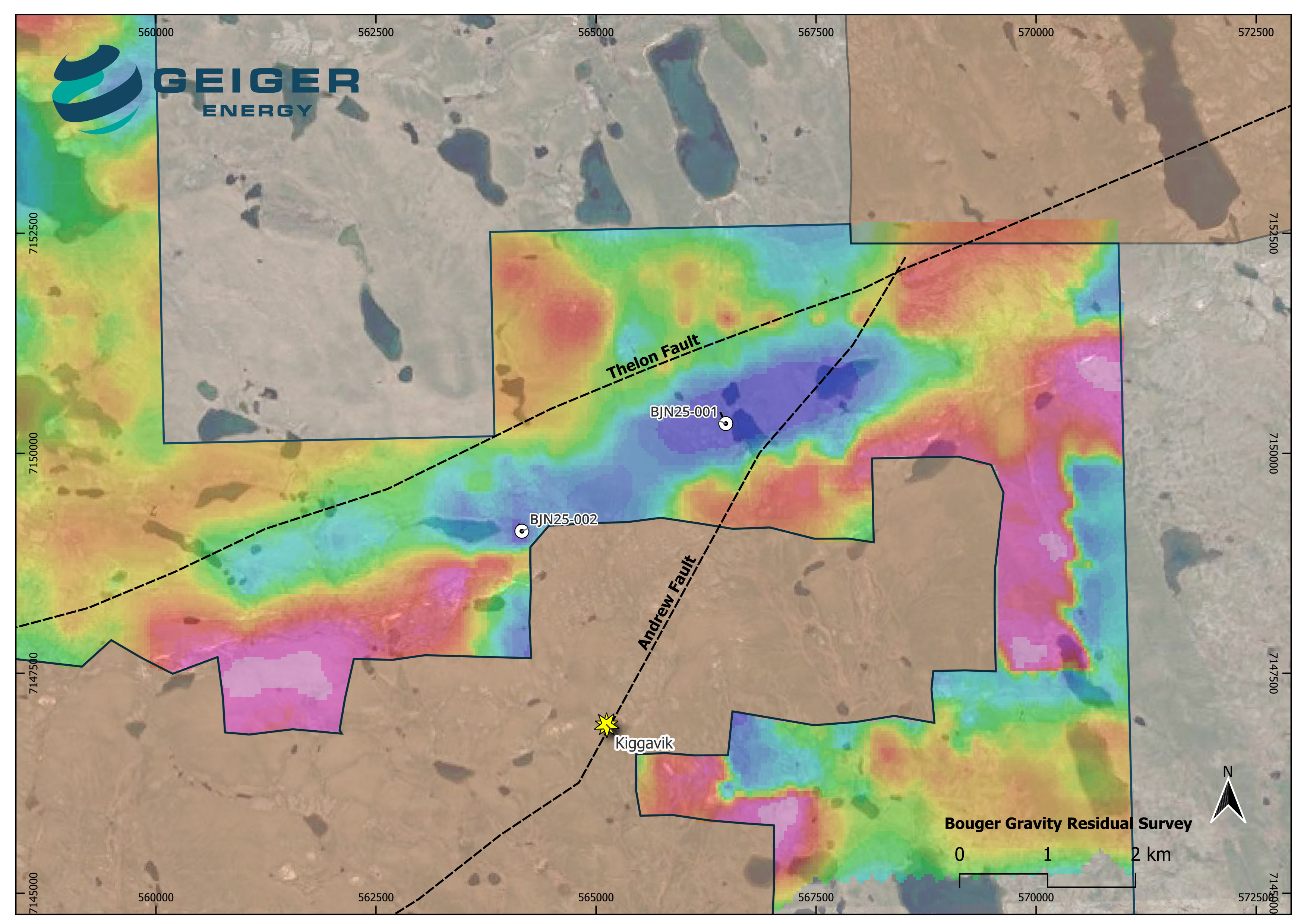
- BJN25-001 intersected sandstone and conglomerate to a depth of 422 m. At the base of the drilling the conglomerate took on a very brecciated texture and indicates that the hole was moving into the main Thelon Fault trace. Alternating patchy bleaching and moderate pervasive limonite alteration is present through out the hole and is indicative of hydrothermal fluids moving through the area but distally.
- BJN25-002 intersected sandstone and conglomerate to a depth of 303 m where the hole was lost. The upper sandstone column to 140 m is pervasively bleached with moderate clay alteration. Extensive broken core, sooty sulphide and limonite are present throughout the entire sandstone column. A largely hematite altered conglomeratic body is present to 246 m and then sandstone proceeds to the end of the hole. Extensive patchy to pervasive bleaching picks up at 263 m and continues to where the hole was lost at 303 m.
- In BJN25-002 above background uranium was intersected in the highly altered sandstone column from 152 to 197 m (up to 3.13 ppm U). Values above background in the altered sandstone is significant and shows that uranium-bearing fluids moved through this area.
Tarzan
Tarzan is a high-priority deep target requiring follow-up drilling.
- Alteration identical to known deposits at Tatiggaq and Qavvik
- Strong clay alteration, hematite remobilization, and structural disruption
- Highly anomalous boron and uranium values in preliminary results
- Drilling to date did not reach optimal depths
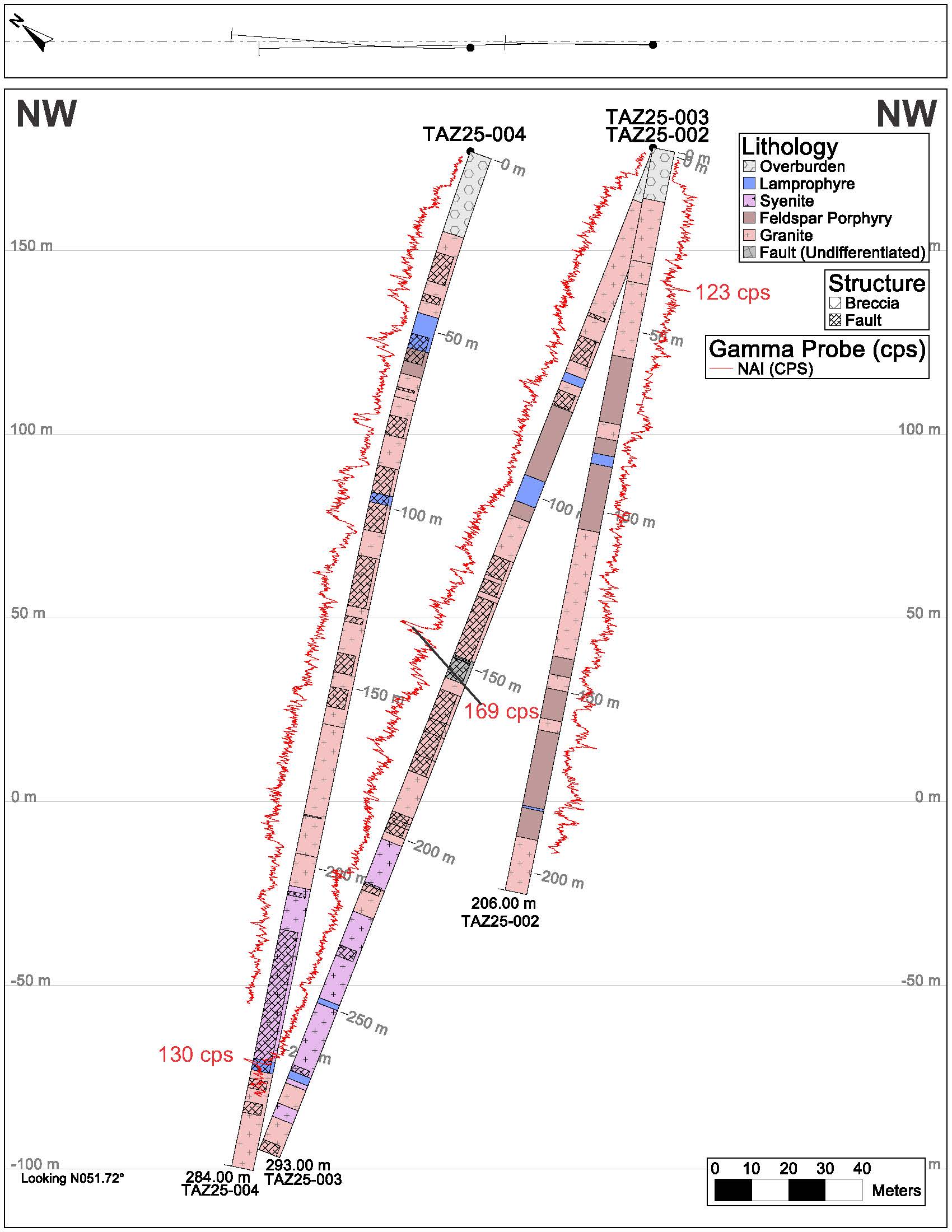
It is located along the prospective NE trend, the Andrew Fault, that several deposits related to the Kiggavik Project (Orano) lie along as well as a prominent ENE fault trend. Four drill holes were completed in the Tarzan anomaly, but several holes encountered challenging drilling conditions and were not drilled to an optimal depth.
- TAZ25-002, TAT25-003 and TAT25-004 intersected very strong clay, bleaching, remobilized hematite and limonite alteration in various intrusive lithologies to the end of their holes. The targets did not get to depth due to drilling difficulty. TAT25-001 intersected moderate alteration and structural disruption and was testing outside the main anomaly targeting a major NE fault.
- The alteration signature is identical to the hanging wall alteration to Tatiggaq and Qavvik and testing is required at greater depths.
- Highly elevated uranium values of 155 and 345 ppm were intersected in TAZ25-003 and coincide elevated B (1,100 ppm), Mo (825 ppm), Co (13.9 ppm) and Ni (147 ppm). These highly elevated values are indicative of uranium mineralization processes similar to Tatiggaq.
- Elevated uranium up to 29.8 ppm was intersected in TAZ25-002 and boron values throughout the Tarzan holes largely exceed 200 ppm with several values over 1,000 ppm. Boron is a key indicator of being in the proximal clay alteration halo of a uranium deposit.
2024 Program
Following the success of the 2023 exploration program, Forum (now Geiger Energy) initiated a comprehensive follow-up drill campaign at the Aberdeen Project. From June through late September, the company completed 6,962 metres of drilling across 30 holes, testing five of more than 20 gravity targets identified to date. Assay results for 7 of the 11 holes drilled at Tatiggaq intersected uranium mineralization. The mineralized strike length at Tatiggaq was extended from 200 metres to over 310 metres. Additionally, two holes drilled at the Qavvik target intersected a 296-metre-wide zone of shallow uranium mineralization, including narrow high-grade intervals up to 8.2% U₃O₈.
Tatiggaq
A total of 11 holes were drilled at the Tatiggaq target as part of the 2023 follow-up program. Highlight intercepts included:
2.25% U₃O₈ over 11.1 m, 1.01% U₃O₈ over 6.2 m, and 0.40% U₃O₈ over 12.8 m
Detailed results include:
- Hole TAT24-012 (Main Zone):
Intersected 1.15% U₃O₈ over 2.4 m (169.1–171.5 m), including:
• 3.33% U₃O₈ over 0.3 m
• 2.77% U₃O₈ over 0.5 m - Hole TAT24-014 (Main Zone):
Intersected 0.62% U₃O₈ over 17.9 m (157.9–175.8 m), including:
• 1.31% U₃O₈ over 7.6 m (164.0–171.6 m), which includes:
– 4.56% U₃O₈ over 0.2 m
– 4.30% U₃O₈ over 0.5 m
– 4.81% U₃O₈ over 0.4 m - Hole TAT24-011 (West Zone):
Intersected 0.11% U₃O₈ over 35.3 m (144.2–179.5 m), including:
• 0.68% U₃O₈ over 1.6 m (170.9–172.5 m)
• 1.24% U₃O₈ over 0.4 m
• 1.12% U₃O₈ over 0.3 m
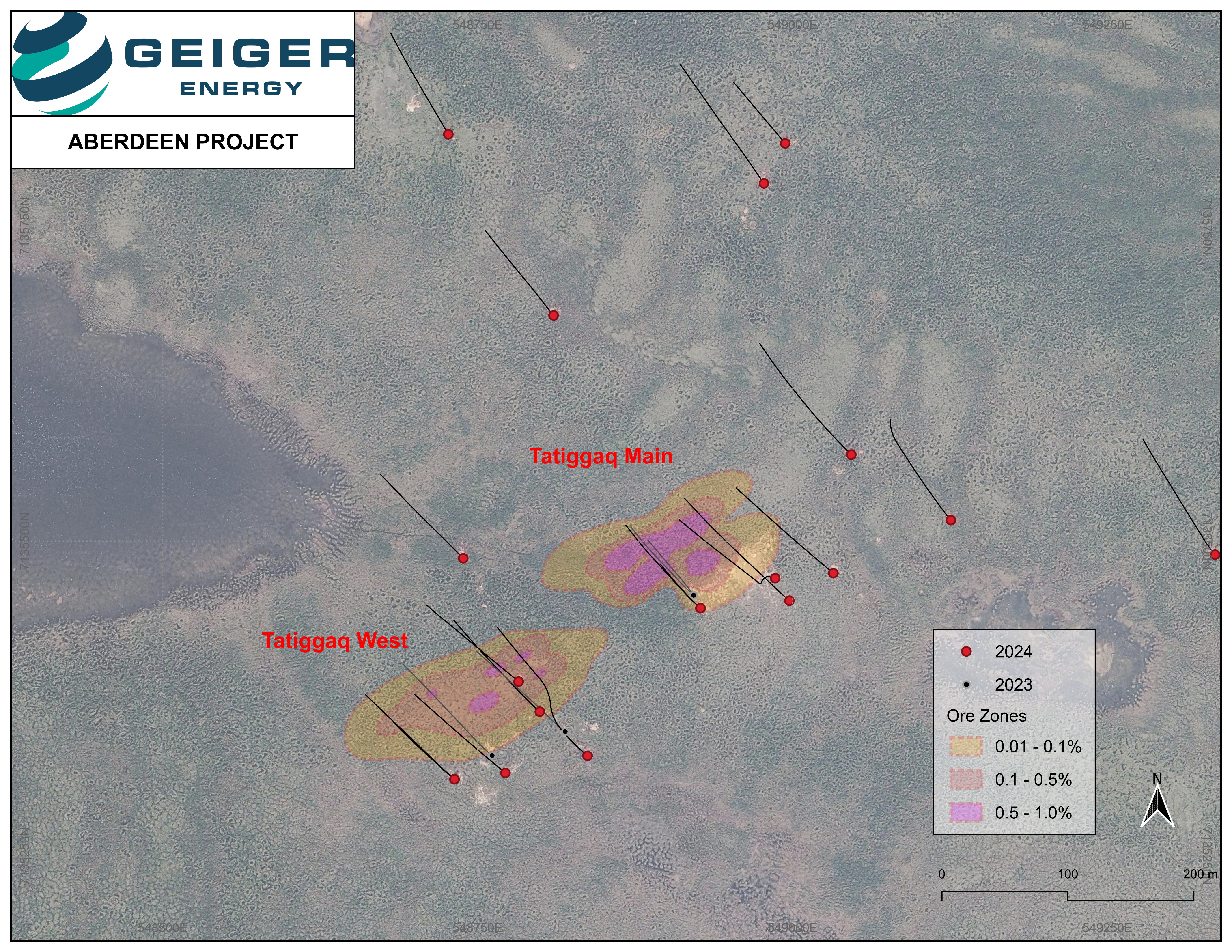
Eight additional holes tested parallel structures within the 0.7 x 1.5 km Tatiggaq gravity anomaly. All eight intersected strong clay alteration, elevated boron, and other uranium pathfinder elements.
Importantly, Hole TAT24-021 intersected uranium mineralization in a new area named Tatiggaq North, located approximately 300 metres north of the Main Zone:
- Hole TAT24-021 (Tatiggaq North):
Intersected 0.38% U₃O₈ over 0.3 m (220.8–221.1 m), including:
• 0.79% U₃O₈ over 0.1 m
Qavvik
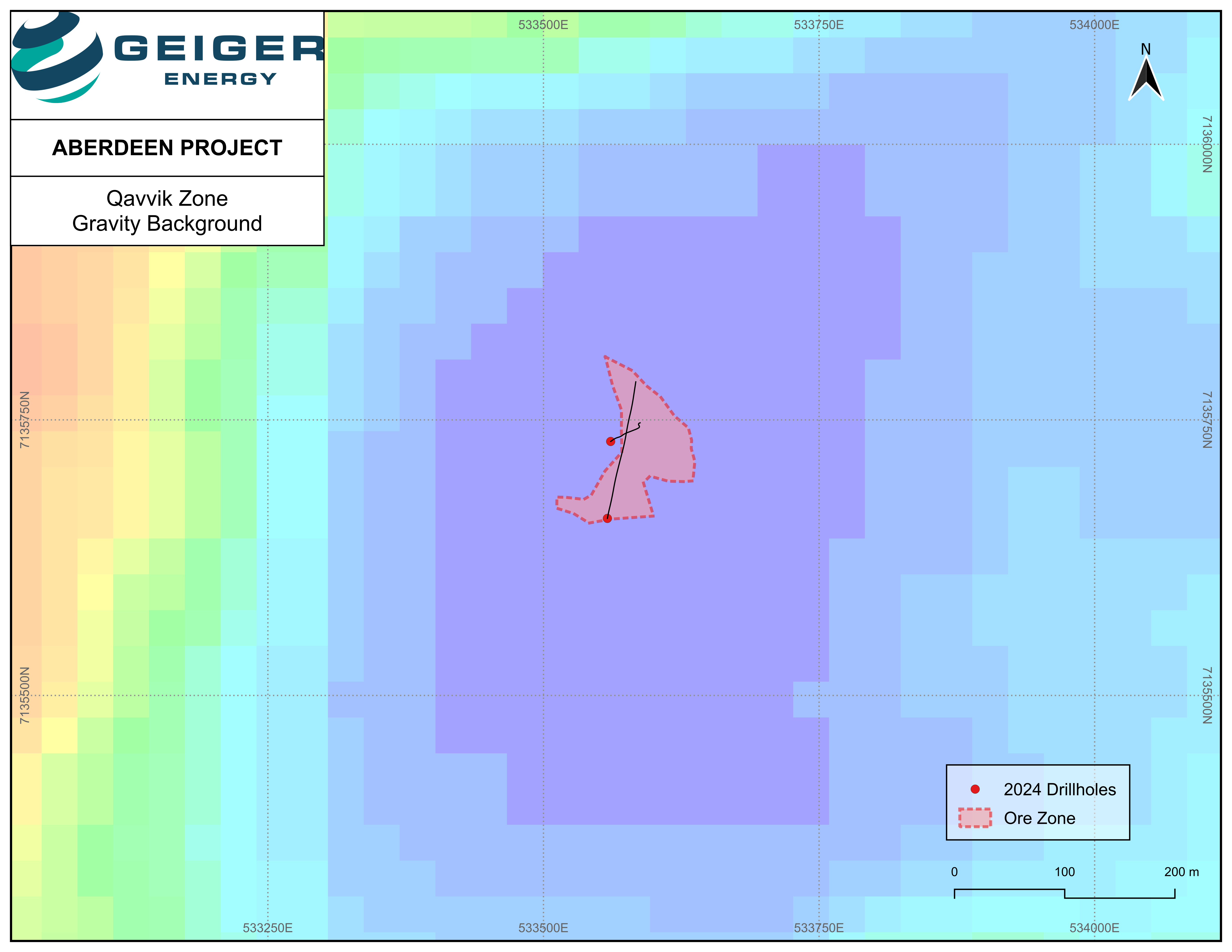
Located 15 km west of the Tatiggaq deposit, the Qavvik target was tested with two drill holes focused on an 800 x 800 m gravity low anomaly previously drilled by Cameco. Drilling intersected a newly identified lens hosting shallow, high-grade uranium mineralization with grades up to 8.2% U₃O₈. Mineralization remains open to the northeast and southwest.
- Hole QAV24-001
Intersected a 296 m wide zone of uranium mineralization comprising multiple discrete lenses from 36–332 m. Highlights include:
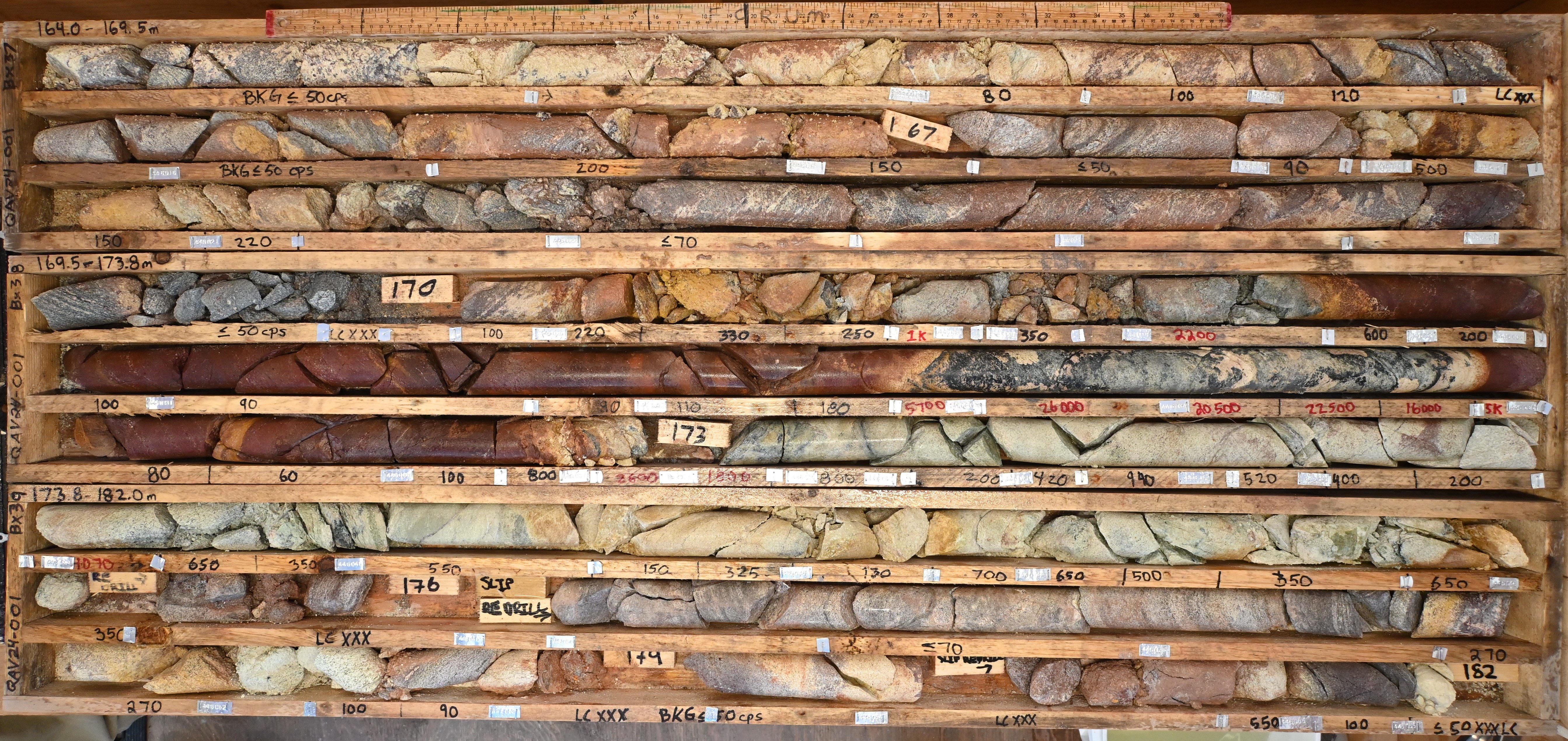
• 1.49% U₃O₈ over 3.3 m (171.9–175.2 m), including 8.17% U₃O₈ over 0.5 m at 172.0 m
• 1.99% U₃O₈ over 0.3 m (205.3–205.6 m)
• 0.82% U₃O₈ over 4.9 m (291.4–296.3 m), including 7.92% U₃O₈ over 0.1 m at 292.3 m
• 0.64% U₃O₈ over 2.7 m (317.1–319.8 m), including 1.22% U₃O₈ over 1.4 m and 6.30% U₃O₈ over 0.2 m at 318.8 m - Hole QAV24-002
Intersected over 190 m of discrete uranium mineralized lenses from 192–384 m. Highlights include:
• 0.40% U₃O₈ over 3.5 m (192.9–196.4 m), including 1.69% U₃O₈ over 0.6 m and 2.44% U₃O₈ over 0.2 m at 196.2 m
• 0.66% U₃O₈ over 1.7 m (197.0–198.7 m), including 3.08% U₃O₈ over 0.2 m at 197.4 m
Ayra / Loki / Ned
At the Ayra and Loki targets, drilling encountered highly elevated uranium and boron concentrations at the sandstone/basement contact—marking the first evidence of unconformity-style uranium mineralization at this contact within the Thelon Basin.
- Uranium values reached up to 72.8 ppm in the sandstone and 323 ppm in the basement, encountered at shallow depths, including down to 115.2 m.
- These results suggest the Ayra and Loki grids may lie in proximity to a uranium mineralized deposit.
- Further drilling and evaluation are warranted to assess their full potential.
2023 Program
From July to August, five drill holes were completed totalling 991 m. The program focused on expanding shallow high-grade uranium mineralization at the primary Tatiggaq basement discovery and drilling the untested Ned gravity anomaly.
-
Drill hole TAT23-002 in the Main Zone intersected 2.25% U3O8 over 11.1m (148.5m-159.6m) including 1.35% U3O8 over 1.7m (148.5m-150.2m), 3.32% U308 over 3.1m (152.2m-155.3m), and 7.27% U3O8 over 1.5m (156.9m-158.4m).
-
Drill hole TAT23-003, a 200m step-out in the West Zone to the southwest. intersected 0.40% U3O8 over 12.8m (136.0m-148.8m), including 1.10% U3O8 over 0.8m (136m-136.8m) and 1.08% U3O8 over 1.3m (143.8m-145.1m). The entire mineralized zone assayed 0.28% U3O8 over 24.6m (129.5m-154.1m) in what is interpreted as multiple uranium lenses within a wide fault zone. The Tatiggaq West Zone is open along strike to both the southwest and northeast towards the Tatiggaq Main Zone, which is also open along strike.
-
Drill hole TAT23-004 in the West Zone (150m southwest of TAT23-002 and 50m northeast of TAT23-003) intersected 0.40% U3O8 over 18.9m (151.4m-170.3m), including 1.01% U3O8 over 6.2m (161.0m-167.2m), including 4.36% U3O8 over 1.3m (164.6m-165.9m).
-
Drill hole NED23-001 at the 2km X 2km Ned gravity low anomaly was lost at 165m in the Thelon clay altered sandstone. However, elevated uranium and pathfinder elements, including Boron, were observed, suggesting the area is fertile for potentially hosting unconformity-type uranium mineralization.
Forum (now Geiger Energy)'s inaugural drill program enabled the exploration team to gain a greater understanding of the geology. Dr. Rebecca Hunter interpreted the Tatiggaq results to be significant as they demonstrated continuity of mineralization within a series of high-grade sub-parallel uranium lenses over a length of 250 m. The presence of multiple sub-parallel trends within the Tatiggaq anomaly reaffirmed the potential for discovering new mineralization.
Past History
During the period from 2008-2012, Cameco drilled 135 holes totaling ~36,000 m to the west of Kiggavik and discovered two uranium deposits - Tatiggaq and Qavvik. A significant showing named Ayra was also discovered.
Due to a prolonged period (~10 years) of low uranium prices Cameco let the mineral claims lapse and Forum (now Geiger Energy) was able to acquire 100% of the claims covering Qavvik and Tatiggaq, which is now the Aberdeen project.
Tatiggaq Uranium Discovery
The Tatiggaq discovery, found in 2010, consists of two zones: the Main and West Zones, which averaged 30 m in thickness at a shallow depth of 80-100 m, and strike lengths of 80 m and 60 m, respectively. Discovery hole TUR-014A intersected 0.85% U3O8 over 13.7 m and 4.03% U3O8 over 0.5 m. Grades of up to 24% U3O8 over 10-30 cm widths with average grades of approximately 1% U3O8 were reported over these two mineralized zones. The deposits remain open along strike and at depth within a large gravity anomaly (0.8 x 1.5 km) that is not fully tested.
Significant intercepts include:
Hole TUR-042
- 2.69% U3O8 over 7.9 m from 200.2 m to 208.1 m. including 24.8% U3O8 over 0.4 m at a depth of 202.9 m to 203.3 m
Hole TUR-052B
- 0.43% U3O8 over 54.2 m at a deth of 115.4 m to 169.6 m
Hole TUR-056
- 0.93% U3O8 over 9 m at a depth of 126 m to 135 m
Hole TUR-058
- 1.17% U3O8 over 6.1 m at a depth of 88.2 m to 94.3 m
Qavvik Uranium Discovery
The Qavvik discovery was found in 2009 and consists of four steeply dipping lenses 5-20 m wide, to a depth of 350 m, over a strike length of 250 m. Drillhole SAN-002 intersected four discreet mineralized intervals grading 0.92% U3O8 over 2.5 m at a depth of 253.9 m to 256.4 m, 1.18% U3O8 over 4.36 m at a depth of 259.0 m to 263.3 m, 0.57% U3O8 over 1.6 m at a depth of 273.3 m to 275.3 m, and 0.62% U3O8 over 2.2 m at a depth of 277.5 m to 279.7 m. The highest grade mineralzation intersected graded 5.69% U3O8 over 0.3 m.
Ayra
The Ayra showing has all the hallmarks of classic unconformity type mineralization with uranium enrichment (67 to 610 ppm U) near the uncomformity along steeply dipping faults that are clearly reactivated fault zones which offset the 10 m to 60 m thick overlying Thelon sandstone. The host rocks to the Ayra showing consist of lampophyre, syenite, and gneiss uncomformably overlain by strong altered and uranium enriched (2 to 11 ppm U) Thelon sandstone. At the time only 15 widely spaced holes had tested the prospect.